Sarah’s story:
“I never imagined I would experience homelessness. I was working full time, living in my own apartment and building a future. My life felt stable and familiar. Then I became seriously ill, and everything changed. I was diagnosed with Crohn’s disease. I couldn’t return to work, and with ongoing hospital stays, surgeries and treatment, my income disappeared. I did everything I could to keep up with my rent, but it just wasn’t sustainable anymore.
I didn’t even realise I was homeless. You don’t think you would ever be in that situation at all. What followed was a period of hidden homelessness. At first, I stayed with family. Then I moved between friends’ couches, and even cars. I was always on the move, never settled, and it took a huge toll on me, especially while trying to manage my illness. I needed my own space and my own bed so I could get my health and my life back under control. My experience is a reminder that ending homelessness isn’t just about having a roof over your head. It’s about feeling safe, stable and independent. Homelessness doesn’t come from just one path, and it can happen to anyone.
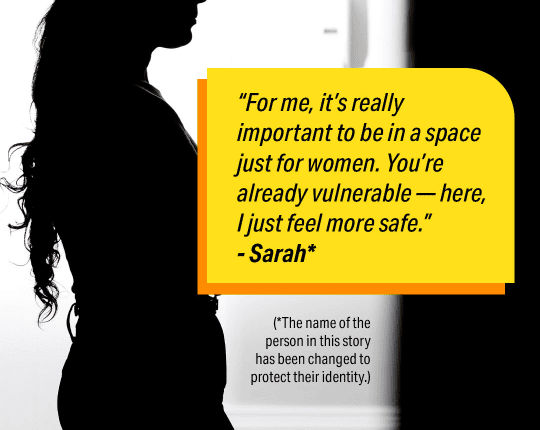
I was referred to Dublin Simon Community’s women ‑only service in Osberstown — a five ‑bedroom home designed to be safe and supportive. For me, it’s really important. I just feel more safe. I didn’t know what to expect when I arrived. I thought it would be like a hostel. But it was nothing like that. Instead, I found calm, space and support. When I got here, I could finally breathe. I had somewhere to stay… I could relax. Today, I’m still managing my health, but I feel stronger and more hopeful about the future. I feel more empowered. I feel like I’ve found myself… I have the excitement to live again.”
Sarah’s* story reflects a reality increasingly seen across homelessness services: more women are experiencing homelessness, and their needs are often shaped by distinct risks and vulnerabilities. In 2025, women accounted for 40%** of those experiencing homelessness, up from 35% in 2020. Within the same time frame, we have seen a 20% increase in the number of women accessing our services, a significant shift that calls for more tailored, gender-specific solutions.
In response, we launched our first women-only service at Osberstown, Co. Kildare. The project was made possible thanks to the support of Kildare County Council, whose partnership has been central to delivering this much-needed service. The five-bedroom, low-support service was designed to provide safe and secure accommodation for women experiencing homelessness and who are preparing to move into independent living. Each resident has a private bedroom, something which clients say helps with their sense of security and dignity. The women in the service range in age from their 20s to their 60s, underlining that homelessness can affect people at all stages of life.
Osberstown is more than accommodation. It is a service shaped by the changing profile of homelessness and by the recognition that effective responses must adapt accordingly. For women who may have experienced trauma, insecurity or prolonged instability, this new service provides the stability to focus on recovery and transition to longer-term housing and a life beyond homelessness. Osberstown represents an important milestone for Dublin Simon. Not only is it a direct response to the crisis, but it recognises the changing nature of homelessness, providing a safe space for women who might otherwise be without one. The service also highlights our commitment to developing specific and responsive services that people experiencing homelessness need to meet their individual circumstances.
Ending Homelessness – A Core Strategic Pillar
Our strategy is rooted in a simple but urgent ambition: to make home a reality for more people, and to do so in a way that delivers lasting, measurable impact. Ending homelessness requires more than simple solutions. It demands a coordinated, sustained and person-centred response that supports people through every stage of their journey. In 2025, Dublin Simon Community continued to expand and strengthen its continuum of care at a time when homelessness was growing in scale and complexity.
Our goal is to deliver housing-led initiatives to move those experiencing homelessness into housing through high-quality services.
Initiatives:
- Crisis Response: Providing a point of contact for the most vulnerable in society by engaging with people who are rough sleeping and ensuring that service delivery is addressing the most urgent needs, including crisis responses, harm reduction and rapid responses to emerging trends.
- Supported Emergency Accommodation: Providing short term, needs-based emergency accommodation for men, women,couples and families who are facing homelessness.
- Advocacy: Advocating for sustained, impactful, national and international policies to prevent and respond to the crisis of homelessness.
Our approach recognises that homelessness cannot be solved through a single action. It requires coordinated responses across housing, health, prevention, and support systems. It means working together to address both immediate needs while creating clear pathways to stability, recovery and long term housing. Because impact is not measured solely by what is provided, but by the meaningful and lasting difference we make in people’s lives. Sarah’s story is just one example of the many lives that have been transformed through this approach.
* The name of the person in this story has been changed to protect their identity.
** The proportion of women experiencing homelessness has increased from 34.8% in 2020 to 39.7% in 2025, Department of Housing, Local Government and Heritage.
Read the full report here: https://www.dubsimon.ie/annual-impact-report-2025