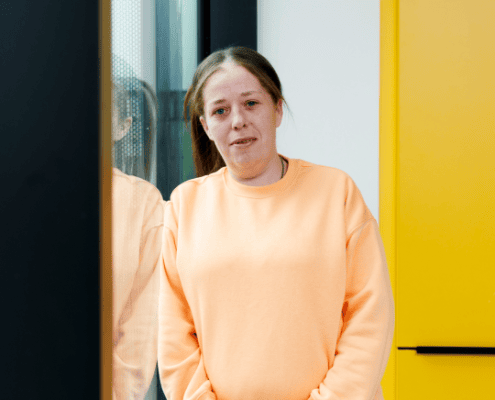
Kayleigh’s Story:
When I first arrived at Dublin Simon Community’s Health and Addiction Care Facility (HACF) at Usher’s Island, I felt something I hadn’t felt in other homeless services before.
It’s the only place that isn’t my home that I actually feel safe. I came to Dublin Simon not long after giving birth to my fourth child. I was still in the grips of addiction at the time, and I had no choice but to place my baby in temporary foster care. Being separated from my newborn was devastating, but I knew I had work to do to get to a place where I could take care of him. If I don’t look after myself first, I can’t look after my kids. I’m 38 now, and I’ve been experiencing homelessness for around 20 years.
I started using substances when I was a teenager and it quickly developed into addiction. I stayed in hostels at different points, but I didn’t feel safe and found it hard to focus on my recovery. A lot of the time, I felt safer sleeping rough instead. After my youngest son was born in the Rotunda Hospital, a Dublin Simon staff member came to see me. They spoke to me about the option of entering a recovery programme with Dublin Simon, and that conversation changed things for me.
Feeling safe at the facility in Usher’s Island helped me face my addiction head on. Once I had that security, I could finally put real focus on my recovery. Before long, I reached a huge milestone — two months sober. I also found a real sense of community in Dublin Simon. I realised I wasn’t on my own and that I could rely on staff and other residents for support, especially other mothers who understood what I was going through. My biggest hope is to be reunited full time with my baby. For now, I visit him twice a week, and every visit reminds me why I’m doing this. I also want to be there consistently for all my children. Being a mam means the world to me. I will make sure I am there for my kids. I know the progress I’ve made is down to finally getting the right support.
Having staff who are always there for a chat and being in a place where I genuinely feel safe, has allowed me to make real strides in my recovery. To other mothers experiencing addiction, I would say never give up hope. The right help is out there, whether it’s through Dublin Simon or somewhere else. For me, Usher’s Island has been a place where I could begin to heal, rebuild my life, and work towards being the mother I want to be.
Health and Therapeutic Enhancement – A Core Strategic Pillar
From decades of frontline experience, Dublin Simon Community understands how health and homelessness are deeply intertwined. Poor physical or mental health, addiction, and trauma are reasons why many people become homeless, while for others, ill health is exacerbated or created by their homelessness experience. Our people understand how health challenges may be intensified by homelessness and hamper the path out of it. That is why our solutions are integrated with each other and our work to end homelessness.
Our goal is to ensure clients are healthier and enjoy a better quality of life as a result of time spent in our services.
Initiatives:
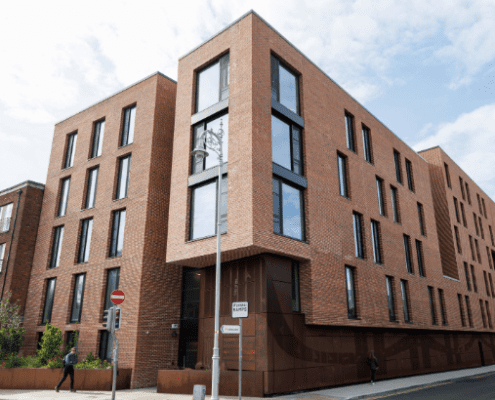
- Clinical Services: Low-threshold health and addiction services for people experiencing homelessness. By October 2025, our Health and Addiction Care Facility (HACF) at Usher’s Island was open for a full year. It is an example of how health challenges, particularly related to addiction, require a bespoke set of solutions – staging posts on the path to recovery. Clients receive, as it is needed, Detox, Recovery, Blood Borne Virus (BBV) care, Step-Up Step-Down (SUSD) support, and stabilisation.
- Therapeutic Services: Addiction recovery services using a Community Reinforcement Approach to support building recovery capital. Dublin Simon also responded to increasing levels of need through our therapeutic support services. Sure Steps Day Counselling and Out-of-Hours Suicide Prevention services delivered over 2,000 hours of support, including unscheduled and phone-based interventions, ensuring that people could access help at critical moments in their lives.
- Priorities of Service Delivery Operational Planning: Training, Quality Improvements, Recovery Capital, Advocacy and Care Models for Clients. Our work is also informed by the understanding that recovery is not linear. Through Client Development programmes, peer-led initiatives and community-based supports, individuals are supported to rebuild confidence, skills and wellbeing as part of their journey out of homelessness. Integrated clinical pathways strengthened significantly in 2025.
Health and Addiction Care Facility: One Year of Impact
In its first year of operation, the Health and Addiction Care Facility at Usher’s Island has demonstrated the impact of a specialist, integrated response to homelessness. At the facility, clients can avail of a number of specialist healthcare services which have been designed to help them overcome addiction.
This is the first time that these health resources and client accommodation have all been together under one roof. In 2025, the facility delivered 487 episodes of care from 788 referrals across its core services – Detox, Recovery, Blood Borne Virus (BBV) care, and Step-Up Step-Down (SUSD) – with high occupancy throughout the year, reflecting both strong demand and the effectiveness of the model. A major measure of that success has been the facility’s role in supporting hospital discharge pathways.
More than 50% of referrals came directly from acute hospital settings, enabling medically vulnerable individuals to leave hospital safely and continue treatment in a more appropriate clinical environment. This has improved outcomes for clients while easing pressure on emergency departments and hospital beds. Capacity continued to grow in 2025 with the opening of the Stabilisation Unit, increasing bed numbers from 51 to 63.
Following a redesign of the service model, which included trauma-informed group supports, client engagement and outcomes strengthened significantly by year’s end. A further 12 beds were approved in late 2025 and would open in early 2026, bringing the total capacity to 75. These results reflect more than the operational growth. The HACF is the outcome of a model devised by Dublin Simon Community from decades of frontline experience, brought to life through partnership with the Department of Housing, Local Government and Heritage, Department of Health, Dublin City Council, and the HSE.
It demonstrates what is possible when a cross-departmental solution is created under a shared goal. With 43 staff recruited in 2025, no nursing vacancies and no reliance on agency staffing, the facility has built a strong foundation for future expansion. As work continues towards the full 100-bed model, the HACF at Usher’s Island stands as a clear example of how integrated solutions are the way forward for addressing such a complex problem as homelessness.
Primary Care Nursing: Healthcare Where It Is Needed Most
Poor physical and mental health are often inseparable from the experience of homelessness. For many people, chronic and untreated illnesses, trauma and limited access to healthcare are simply part of their daily lives. Dublin Simon Community’s Primary Care Nursing Team plays a vital role in changing that reality.
The team monitors and treats clients’ health conditions when within services and ensures clients receive timely treatment. Working across short-term and long-term accommodation services, the team provides clients with direct access to specialist health treatment and care.
With a mix of general and mental health expertise, along with specialisms in women’s health and tissue viability, the team is equipped to deal with the wide variety of injuries and illnesses that our clients present with. Underlining the increasing needs for this type of service, 2025 was a landmark year for Primary Care Nursing at Dublin Simon with 2,043 healthcare interventions, up 7% from 2024.
The team worked with Safety Net to develop a GP pilot scheme in longterm accommodation services, strengthening integration between primary care and inclusive health services. Collaborating with the National Screening Service, they also rolled out on-site diabetic retina screening in Chester House, a first-of-its-kind service in homeless accommodation. A further milestone was the establishment of an outreach-based, nurse-led women’s health service. This team focuses on engaging women who are rough sleeping, recognising the specific and often complex needs within this group and supporting them to access services for health and maternity care.
In addition to the direct impact and support provided to clients, the team plays a significant role in reducing demand on public emergency departments and avoiding unnecessary hospital admissions through the delivery of timely, community-based interventions. By providing consistent monitoring to clients, particularly those with chronic conditions, the service is able to identify early changes in health status and respond promptly.
This proactive approach supports early intervention, helping to prevent the progression of conditions to more acute presentations. Where clients require care beyond the scope of the service, the team ensures appropriate onward referral and coordinated access to specialist services, supporting continuity and quality of care.
Primary Care is central to Dublin Simon’s integrated model of care. Breaking down barriers to ensure clients receive the health and medical care they need is at the heart of the team’s mission. Through this, they contribute to improving the quality and longevity of life for Dublin Simon’s clients.
Client Development: Building Skills, Confidence and Futures
Dublin Simon’s work in Client Development recognises that ending homelessness requires a multifaceted approach. Housing and healthcare solutions are incredibly important, but opportunities for upskilling and self-development must not be overlooked. It’s often that these additional resources and peer-to-peer experiences give clients the support they need to believe in themselves again and feel that they can pursue a life beyond homelessness.
In 2025, over 250 people experiencing homelessness participated in our Client Development programmes. These programmes are designed to help people rebuild their confidence and nurture the skills they need to thrive in life after homelessness. Client Development includes a range of personal development classes, which allow participants the opportunity to reflect on who they are and who they’d like to become. Practical skills are also at the heart of the Client Development course catalogue, with digital skills training and preparation for college courses available. In 2025, 20 new clients availed of volunteering and educational grants to access third-level education.
A particularly notable success last year was the transition from participant to instructor of a client named Christina after she successfully developed her own programme, ‘Bridge to Freedom’. Christina designed the peer-led programme to help people in their recovery journey, informed by her own path to recovery. The Bridge to Freedom programme allows clients to build practical wellbeing tools through group activities, shared experiences and reflective practice.
Beyond upskilling activities, creativity was also a core part of Client Development. Clients are encouraged to express themselves through their preferred artistic medium, whether drawing, painting or writing. Engaging with difficult topics through this lens of creativity can become a healing therapy in and of itself. The culmination of clients’ artistic efforts forms a showcase and book called ‘Scrappy but Happy’. 2025 marked the 15th edition of the publication, which featured a range of clients’ creative works and underpinned a focus on equipping clients with the skills and resilience to build a better future for themselves.
Food for Simon: More than a meal
Food for Simon was established in 2009 to create a reliable supply of essential food items to Dublin Simon Community’s services, and to reduce the costs of purchasing food. In 2025, Food for Simon operated as a critical part of Dublin Simon Community’s frontline response, delivering over 350,000 nutritious meals served to clients throughout the year, which equates to approximately 950 meals a day across emergency accommodation, long-term supported accommodation, treatment services and outreach.
Food is essential. It stabilises. It reduces immediate pressure, supports physical health, and creates the conditions for engagement. The programme is sustained by a network of regular donors and one-off supporters, whose contributions of food allow Dublin Simon to deliver this support efficiently and at scale. In the context of rising need and increasing complexity, Food for Simon remains a simple but essential intervention in a community effort to ensure that no one is left without quality meals.
Read the full report here: https://www.dubsimon.ie/annual-impact-report-2025